V030 – MAPLE BURL

Highly decorative elements such as fillings or fronts in interior design and furniture construction. Maple burl often has bark intrusions, and healthy, large-area tubers are extremely rare and very expensive. They are practically always fully grained.

V031 – PINE CROWN

Most common species of tree in the world. Its subspecies are found from the Arctic Circle to the mountain regions in the tropics. The most used species for the production of veneer in central Europe are the common pine and in southern Europe the maritime pine.

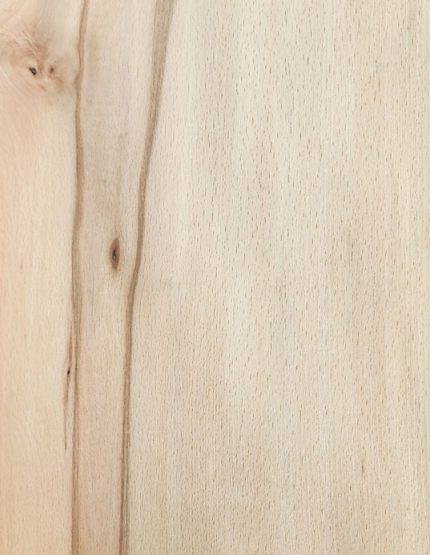
V032 – BEECH BACKING

Veneer wood has large dimensions compared to other European woods (60 cm diameter and more), furniture and parquet wood, chipboard, excellent bending wood (seating furniture), well suited for workbenches, good construction wood. One of the most common woods in Europe is produced as a veneer in steamed, white, and old white. Since the mid-1990s, beech has been a distinctly fashionable wood in the veneer and solid wood sector.

V033 – LACEWOOD

Has a very conspicuous flecking that gives this wood its namesake. The wood itself is a reddish brown with grey or light brown rays, which result in a lace pattern when quartersawn. Like other woods that exhibit the strongest figure in quartersawn pieces, (such as Sycamore), Lacewood has the most pronounced figure and displays the largest flecks when perfectly quartersawn; this is due to the wood’s wide medullary rays, whose layout can be seen the clearest when looking at the end grain.

V034 – EUCALYPTUS

In its simple form – cf. Eucalyptus Pommele, Eucalyptus Riegel – it is rarely used as a front veneer, mostly as a side and interior veneer, because the wood is not very expressive. In addition to veneer production, eucalyptus is used for ship and vehicle construction, for railway sleepers, and as plantation wood, mainly for paper production.

V035 – TULIP

Sliced ​​and peeled wood, is used almost exclusively for indoor purposes as it is extremely susceptible to weathering. In southern Europe, it is also sometimes used as a veneer for series furniture production in the lower price segment.

V039 – FIGURED SYCAMORE VENEER QUARTER

Used as veneer, plywood, interior trim, pallets/crates, flooring, furniture, particleboard, paper (pulpwood), tool handles, and other turned objects.

V041 – FIGURED MAKORE VENEER

The machining is carried out without any difficulties, but due to the reluctance of the chips, the feed rate should be kept low. Furthermore, the tool-cutting edges quickly become blunt due to silicon deposits.

V042 – ANIGRE

Veneer wood is mostly used as interior veneer in Central Europe; if used as front veneer, then as cherry substitute wood. In Southern Europe more often used as a front veneer for series furniture. Also used in North America for high-quality interior design purposes, but mostly in the planned form. Special wood for printing and dyeing. In Italy, Spain, and Greece, walnut sapwood substitutes for wood. Also used for the production of fineline veneers.

V045 – ROUGH CUT VENEER QUARTER

Due to the strong mixing of the individual species, the color spectrum is broad, from light yellow to dark brown. Variations to pink are also possible. So-called minerals, dark colorations that appear as clearly defined spots on the surface, are common. In wet wood, blueing is possible due to contact with metal.

V046 – AFROMOSIA

For exterior surfaces, DD varnishes or open-pored glazes are recommended. NC varnishes are recommended for interior areas. A surface treatment should be carried out to prevent reaction stains caused by iron.

V047 – OAK BURL

The main quality criterion of burl oak is the ingrown bark, which can be found in almost every tree. The less ingrown bark, the higher the quality of the veneer, as significantly less time is required for processing. Trunks without ingrown bark are extremely rare.